
Wahl Clipper Guards: Sizes and What Each Number Cuts
A guard number is what stays on your head, not what gets removed - a #2 leaves about 1/4 inch (6 mm), a #4 about 1/2 inch (13 mm). For a first home haircut, start with a #4 or higher; you can always go shorter on the next pass.
Guard numbers are the most misread thing in home clipping. The number is what stays on your head, not what comes off - a #2 leaves roughly a quarter of an inch behind, it does not remove a quarter of an inch. Get that the wrong way round once and the haircut is decided for the next three weeks. This page maps the numbers to actual lengths, explains why the same number cuts differently on another brand's clipper, and covers what to do when one goes missing.
Guard sizes in inches and millimetres
Standard guard sets follow eighths of an inch, stepping up roughly 3 mm at a time:
| Guard | Leaves | Metric | Typical use |
|---|---|---|---|
| #1 | 1/8" | ~3 mm | Very short fade, just off the skin |
| #2 | 1/4" | ~6 mm | Short back and sides |
| #3 | 3/8" | ~10 mm | The most common all-over length |
| #4 | 1/2" | ~13 mm | Longer sides, still tidy |
| #5 | 5/8" | ~16 mm | Blending into longer top hair |
| #6 | 3/4" | ~19 mm | Bulk removal without going short |
| #7 | 7/8" | ~22 mm | Longer taper work |
| #8 | 1" | ~25 mm | Trimming length off a full head |
Some sets include half sizes (#1½, #2½) which sit between the whole numbers and matter most when blending, because the jump from one whole guard to the next can leave a visible line.
Why the same number cuts differently elsewhere
Guard numbering is a convention, not a standard. The number-to-length mapping above holds for common Wahl sets, but another manufacturer can ship a #3 that leaves a noticeably different length, and cheap unbranded sets are the worst offenders - the moulding tolerance alone can shift the result by a millimetre or two.
There is a second variable people miss: the blade underneath. A guard sets the distance from the cutting edge, so if the clipper's taper lever is open rather than closed, or a different base blade is fitted, the same guard leaves more hair. If you are trying to reproduce last month's haircut exactly, note the lever position along with the guard number.
Popular options on Amazon
Prices change often - check the current price on Amazon.


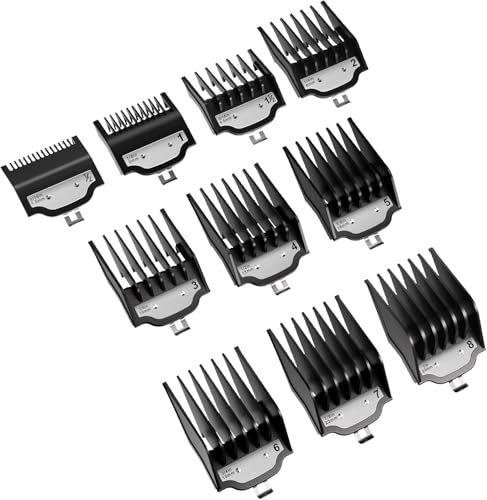


Replacing a single lost guard
Guards are sold individually and in sets, and the cheap answer is usually the set - buying three singles typically costs more than a full replacement set, and the sizes you lose are rarely the ones you can do without.
Fit is by clipper family rather than by number. A guard is held by the clipper's blade housing, so a set made for standard full-size clippers will not sit properly on a trimmer or a compact model. Check the listing for the clipper it is made for, not just the sizes included.
Colour-coded sets are worth the small premium if more than one person uses the clipper. Reaching for a guard by colour rather than squinting at a moulded number is how you avoid taking a #1 to the top of someone's head.
Guards that will not clip on
If a guard rocks or pops off mid-cut, the usual causes are simple. The blade may not be fully seated after cleaning - reseat it and check the guard again. Hair packed into the guard rails stops it sliding home; a brush clears it in seconds. And a guard that has been dropped often has a hairline crack at the clip, which is not repairable and will keep releasing under load.
A guard that fits but moves during a cut leaves steps in the hair, and it is easy to blame the blade for that. Check the guard first - it is the part that most often goes unnoticed.
Caring for guards
Guards need almost nothing: brush the hair out, wash occasionally in warm soapy water, dry fully before storing. What they do not tolerate is heat - leaving them near a radiator or in a car in summer warps the plastic enough to change the cut length, and a warped guard is scrap.
Store them in a holder or the original case. Loose guards in a drawer get chipped at the clip edge, and that is the part doing all the work.
Frequently Asked Questions
Does a #2 guard cut a quarter inch off?
Are Wahl guards compatible with other clipper brands?
What guard number is best for a first home haircut?
Why does my guard leave lines in the hair?
Ready to check the latest price?
Check Guard Sets on Amazon