
Wahl Blade Size Chart
Guard and blade numbers run opposite ways: guard numbers rise as the cut gets longer (a #8 leaves about an inch), blade numbers rise as the cut gets shorter (a #10 leaves about 1.5 mm, a #40 is surgical-close). Confirm which system a listing uses before buying.
Two numbering systems run alongside each other and they work in opposite directions. Guard numbers go up as the cut gets longer - a #8 leaves an inch. Blade numbers go up as the cut gets shorter - a #10 leaves more than a #30, and a #40 is surgical. Mixing the two up is how people order a blade expecting a trim and receive one that takes hair to the skin.
Detachable blade numbers
Detachable blades follow a numbering convention shared across several manufacturers, where a higher number means a shorter cut:
| Blade | Leaves approx. | Typical use |
|---|---|---|
| #10 | ~1.5 mm | General close work, common all-rounder |
| #15 | ~1.2 mm | Slightly closer than a #10 |
| #30 | ~0.5 mm | Very close, often used under guards |
| #40 | ~0.25 mm | Surgical, skin-close |
Because the shortest blades cut close enough to catch skin, they are normally used with a guard on top rather than bare - the blade sets the base length and the guard sets what you actually leave.
Guard numbers, the other direction
Guards run the opposite way and in eighths of an inch: #1 leaves about 3 mm, #2 about 6 mm, #4 about 13 mm, #8 about 25 mm. Full mapping is on the clipper guards page.
The practical consequence: "a number two" means completely different things depending on whether the person is talking about a guard or a detachable blade. In a barber's chair it is nearly always a guard. In a grooming context it is often a blade.
Popular options on Amazon
Prices change often - check the current price on Amazon.


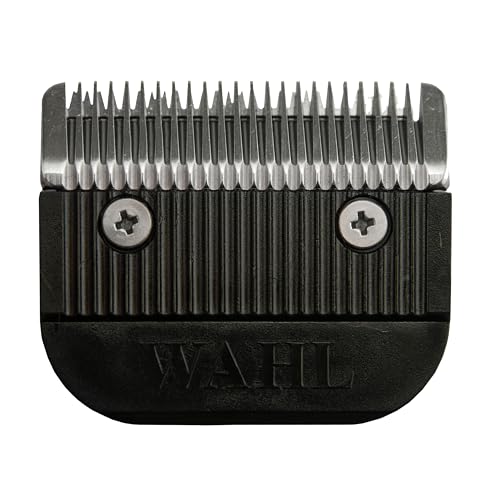


Taper lever, the third variable
On adjustable-taper clippers the side lever changes cut length continuously between the blade's closed and open positions - typically somewhere around 1 mm to 3 mm depending on the machine.
This matters when reproducing a cut. Guard number plus blade type is not the full description if the lever moved; the same guard over an open lever leaves visibly more hair than over a closed one. If a haircut came out right, note the lever position too.
Reading a size before you buy
Listings are inconsistent about which system they are quoting, so check for a length in millimetres or inches rather than trusting the number alone. A blade listed as "#10 - 1.5 mm" is unambiguous; one listed as "size 10" with no length could be either system.
If the listing gives no length at all and no compatible-model list, treat that as a reason to look elsewhere. The information is standard, and its absence usually means a generic import with no particular fit in mind.
Frequently Asked Questions
Is a #10 blade the same as a #10 guard?
Which blade number is used most?
What does the taper lever change?
Why do two blades with the same number cut differently?
Ready to check the latest price?
Check Blades on Amazon